
The Minimum Viable Meal -Japanese Food as Household UX
Applying Agile Product Design to the Kitchen: Why 'Ichiju Issai' is the Minimum Viable Product (MVP) your household needs to prevent burnout.
Some version of this happens in most households, a few times a week:
It’s 6pm. You’re tired. You open the fridge, stare at it for a moment, close it again. You open it a second time, as if something will have changed. Nothing has.
What should I make tonight?
This question — so small, so daily — is quietly exhausting.
Not because cooking is hard. But because the standard we’re cooking against has become impossible.
The pressure we don’t talk about
Somewhere along the way, the home-cooked dinner became a performance.
It should be balanced. Colorful. Something the kids will actually eat. Not too much sodium. Ideally made from scratch. Ready in 30 minutes. And if possible, the kind of thing someone might photograph.
No single meal can carry all of that.
And yet, every evening, we stand in the kitchen and feel vaguely guilty that it doesn’t.
The problem isn’t that we’re bad at cooking. The problem is that we’ve been handed a definition of “good dinner” that was never designed for real households, on real weeknights, with real levels of exhaustion.
We’ve been optimizing for the wrong thing.
A philosopher in the kitchen
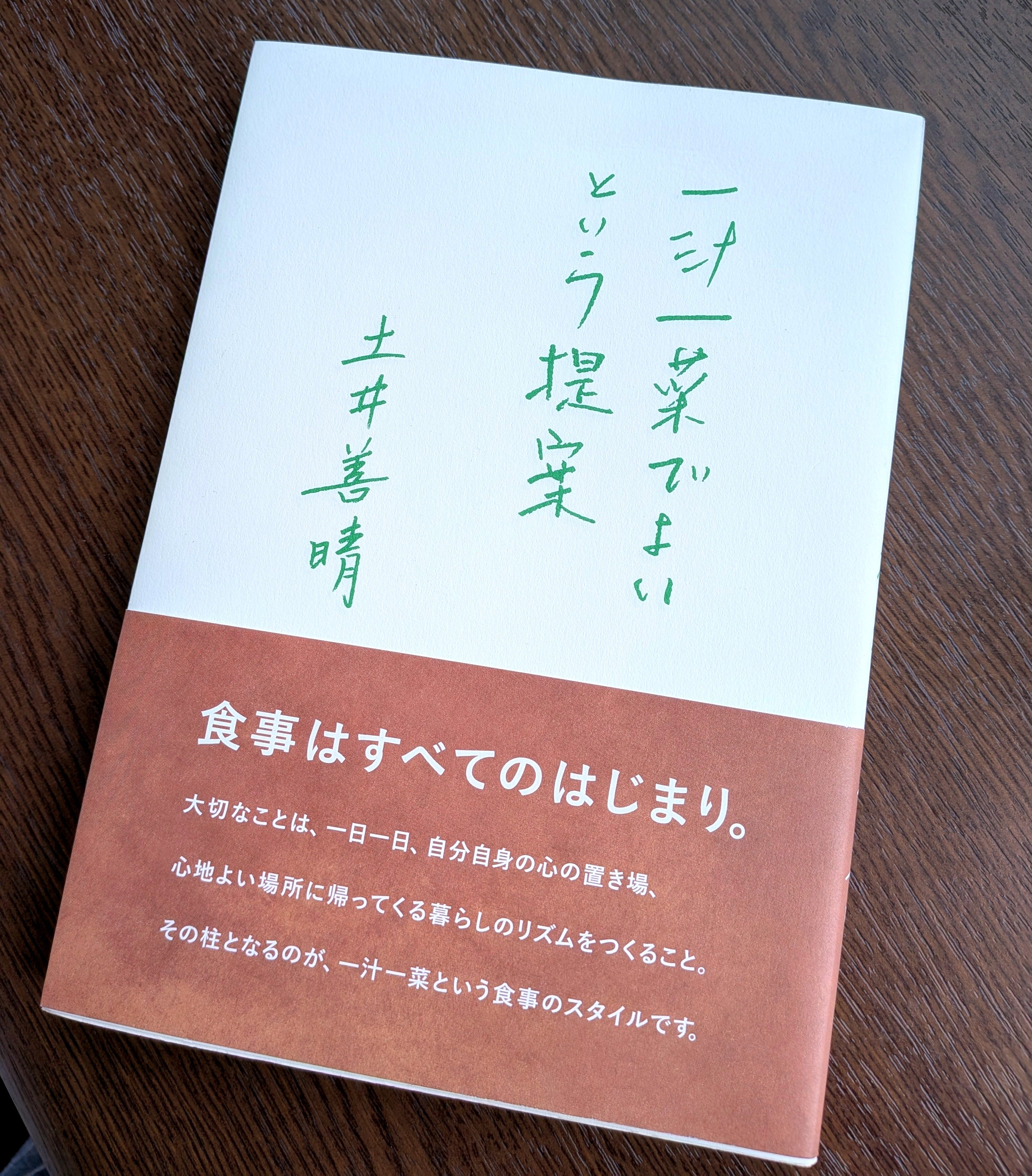
In 2016, a Japanese chef named Yoshiharu Doi wrote a small, quiet book that caused an unexpected stir.
His argument was simple: 一汁一菜 ichiju issai — one soup, one dish — is enough.
Not as a compromise. Not as a backup plan for busy nights.
As a philosophy.
Rice. Miso soup. One side dish. That’s the complete meal.
Doi wasn’t being minimalist for the sake of it. He was returning to something older — a structure that had sustained Japanese households for centuries, before the postwar era inflated expectations around home cooking and turned dinner into an act of proof.
His book sold over a million copies.
I think people were hungry for permission.
The MVP you already know
If you’ve worked in product design or tech, you know the concept of the MVP — the Minimum Viable Product.
The idea is this: don’t build the full thing before you know it works. Build the smallest version that still functions. That still delivers real value. That you can actually ship.
The MVP isn’t the final product. But it’s not a lesser product, either. It’s a complete one — complete for its purpose.
Ichiju issai is the MVP of the home kitchen.
Rice is the anchor — caloric, grounding, universally acceptable. Miso soup is warmth and umami and the smell that says home. One side dish is enough variety to make it feel like a meal.
This structure doesn’t just work. It works reliably. And reliability, on a Tuesday night when you have nothing left, is worth more than impressiveness.
What “functioning” actually means
Here’s a reframe that changed how I think about weeknight cooking:
The goal of dinner is not to be impressive.
The goal is for the household to function.
Functioning means: people ate. The table had some warmth to it. No one went to bed hungry or unsettled. The cook didn’t spend the evening resenting the kitchen.
That’s it. That’s a successful dinner.
When I started measuring meals against that standard instead of the imaginary perfect plate, something shifted. The bar didn’t lower — it became real. And real is something you can actually clear, every night, without burning out.
Ichiju issai clears that bar easily. It’s built for it.
Fewer dishes is not less love
I want to say this clearly, because I think it needs to be said:
Reducing the number of dishes on the table is not a reduction in care.
The care is in the rice, cooked properly. The care is in the miso soup, made with dashi that has depth. The care is in showing up to the kitchen at all, on a night when you had nothing to give.
In fact, I’d argue the opposite is true: insisting on five dishes when you have energy for two is a kind of dishonesty. The meal becomes a performance of effort rather than an act of care.
Ichiju issai asks you to be honest about what you have. And to trust that what you have — rice, soup, one dish, made with attention — is genuinely enough.
Washoku — Japanese home cooking — is, at its core, a cuisine of elegant subtraction. Not sparse out of poverty, but refined through restraint. It is grounded in ingredients, in seasonality, in the small daily pleasures of what’s available right now. This connects to something deeper in Japanese thought: mottainai, the sense that nothing should be wasted, and taru wo shiru — knowing when enough is enough.
The default setting
Designing the minimum that works for your household is where the foundation begins.
In Family Meal OS, I think of ichiju issai as the household’s default setting.
Not the ceiling. Not the floor. The baseline — the configuration you return to when you’re tired, when you’re busy, when the week has been too much.
From the baseline, you can always add. A second dish when you have the energy. Something special on a Friday. A celebration meal when the occasion calls for it.
But the baseline holds. It’s always there. And knowing it’s there — knowing that rice and miso soup and one thing is enough — removes a particular kind of low-grade anxiety that most households carry every single day.
That anxiety has a cost. We just rarely name it.
Tonight’s permission slip
If you’re reading this on a weeknight, here’s what I want you to take with you:
You don’t need to make something impressive.
You need to make something that lands.
Rice. Something warm in a bowl. One thing on the side.
That’s not giving up. That’s design.
Here’s how to cook fluffy, white rice.
The Art of Gohan: A Professional Chef’s Guide to Perfect Steamed Rice

After 10 years of sharing the joy of Japanese cooking on my blog, I am thrilled to start this new chapter on Substack. My mission remains the same: to bring authentic, professional Japanese flavors into your home kitchen.
This project has just launched (v1.0.0). I am building and open-sourcing the Washoku OS live, week by week. Subscribe to become a core contributor and design the future of household UX with me.